
𝗛𝗼𝗹𝗶𝗱𝗮𝘆𝘀 & 𝗧𝗼𝗽𝗰𝗹𝗮𝗱 𝗖𝗼𝗺𝗽𝗮𝗻𝘆 𝗖𝗹𝗼𝘀𝘂𝗿𝗲
Read more
Across Europe, laser cladding continues to gain relevance in industrial manufacturing. Market reports confirm steady growth, but based on our daily work at Topclad, the most significant changes are not only about volume. What we see in practice is a structural shift in how companies approach wear, asset value and production continuity.
Below are three developments that stand out for 2026.
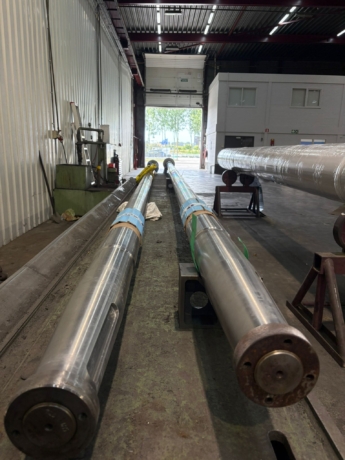
In earlier years, we regularly saw severely worn parts being replaced as a default decision. Large hydraulic rods, industrial rolls and shafts were scrapped once tolerances were exceeded.
Today, we increasingly receive enquiries at a much earlier stage. Instead of asking for a new component, customers ask whether restoration is technically feasible and economically justified.
In many cases, only specific functional zones are worn. The base material remains structurally sound. With controlled laser cladding, we rebuild those surfaces while preserving the original component core. This shift is not theoretical. We see it directly in project intake and repeat business.
In Europe, high alloy prices and extended delivery times for large forged parts play a role. But beyond cost, there is a broader awareness that replacing an entire component is often unnecessary.
We increasingly work on components that have already been restored once before. That indicates a change in long-term asset strategy. Instead of viewing cladding as a last-resort repair, it is integrated into planned maintenance cycles. From our perspective, laser cladding is becoming part of structured lifecycle management rather than reactive maintenance.
When Topclad started, our work was strongly connected to the dredging industry. Over time, that concentration has shifted. Today, we regularly apply laser cladding in:
The enquiries we receive are more diverse than they were five or ten years ago. In many cases, companies approach us after seeing similar solutions implemented in another sector.
This diversification has practical consequences. Knowledge gained in one industry improves performance in another. Powder selection, heat input strategies and dilution control are continuously refined through accumulated experience.
Because we work across multiple sectors, we see patterns earlier. Wear mechanisms differ, but the underlying surface challenges are often comparable. That transfer of expertise strengthens reliability and predictability. For 2026, we expect further steady growth across sectors rather than a concentration in one dominant industry.
According to recent market analysis by Grand View Research, the growth of laser cladding is closely linked to increasing automation and integration into advanced manufacturing environments. The report highlights a rising role of OEM-driven applications and continued technological refinement of laser systems.
This aligns with what we observe in practice. As laser cladding moves beyond isolated repair cases and into more structured production contexts, expectations regarding consistency and repeatability increase.
The metallurgical bond between clad layer and base material remains the critical success factor in laser cladding. Layer quality, dilution control and structural integrity are non-negotiable fundamentals.
What is changing is not the importance of these parameters, but the scope of evaluation. In addition to metallurgical performance, customers increasingly assess process stability, documentation and integration within broader manufacturing systems.
Advances in laser sources and control systems make tighter management of heat input and dilution technically feasible. However, implementation remains experience-driven.
The increasing availability of laser cladding systems across the market does not automatically translate into consistent coating quality. While more machines are being installed, achieving a stable, defect-free layer still depends on parameter control, material selection and practical experience.
In our work, we regularly see that successful applications require a deep understanding of heat input, dilution behaviour and substrate interaction. Equipment enables the process, but expertise determines the outcome. In that sense, the development is twofold: technological capability is increasing, and at the same time, customer expectations are becoming more structured.
From our perspective at Topclad, the European market is not only expanding; it is maturing.
We see:
Laser cladding is gradually shifting from a specialised repair technique toward a recognised and structured surface engineering capability.
The growth figures confirm the direction. Our experience in the field confirms the underlying shift in mindset.
Topclad is Europe’s leading manufacturer of innovative laser clad layers, based in Lelystad, the Netherlands. We specialize in developing and applying laser clad layers for the most demanding industries, including oil & gas, offshore, dredging, mining, bridges & water locks, steel manufacturing, and food processing.
Our mission is to provide components with superior protection against wear, corrosion, and impact, resulting in significantly improved reliability and uptime of capital-intensive equipment. With over 16 years of experience, a steadfast commitment to quality, and a proven track record of over 15,000 laser cladded components, we deliver solutions that enhance the performance and longevity of your critical machinery.
"*" geeft vereiste velden aan
 English
 German
 Dutch
Dutch French
 Italian